Given that our regular meeting date of the first Thursday of each month falls on the day after the July 4 holiday, the CNP directors have decided that it would be better to delay the meeting one week. We will therefore meet on Thursday, July 12 at 7:30pm. Enjoy the holiday, and then come and join us at the meeting the following week!
Category Archives: Uncategorized
Photo Assignment for July
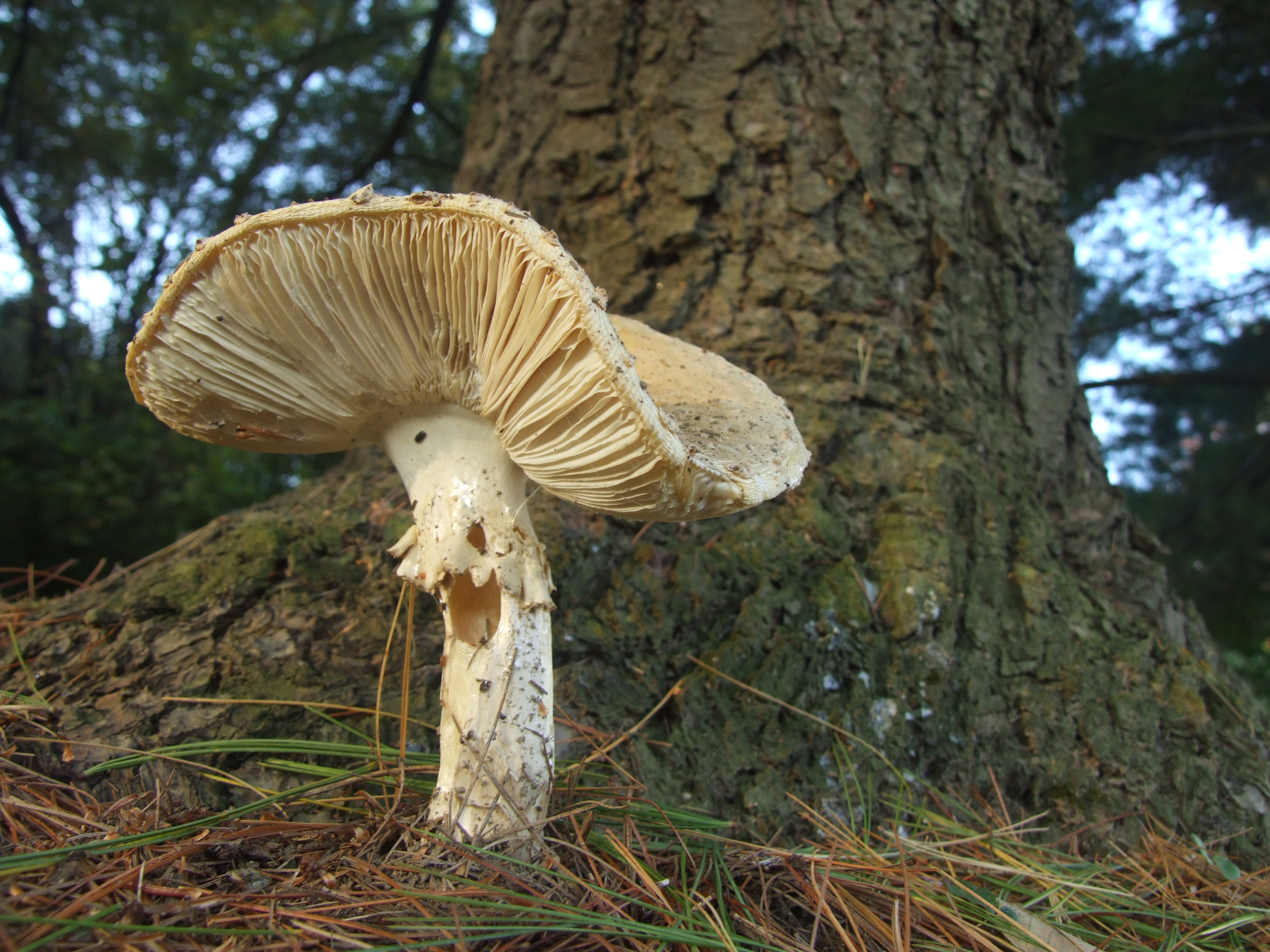
The photo assignment for July is “Ant’s Eye View.”
The point of this exercise is to play with perspective by taking photos with your camera on, or just above, the ground.
As an example, here’s a photo I took a few years ago that demonstrates the concept.
Happy shooting!
Just a quick post from today..
Have to post this one photo of a Chestnut-sided Warbler in full voice. Went to a park very near home and found the bushes alive with birds due to the spring migration. It was mostly Chestnut-sided Warblers with a few Yellow Warblers, Wood Thrushes and Song Sparrows. The males seemed totally driven to out-sing one another, and to jump around trying to find their rivals. Never saw a female, and wonder if the females, as with so many birds, trail the males by a few weeks. Anyone know about that?
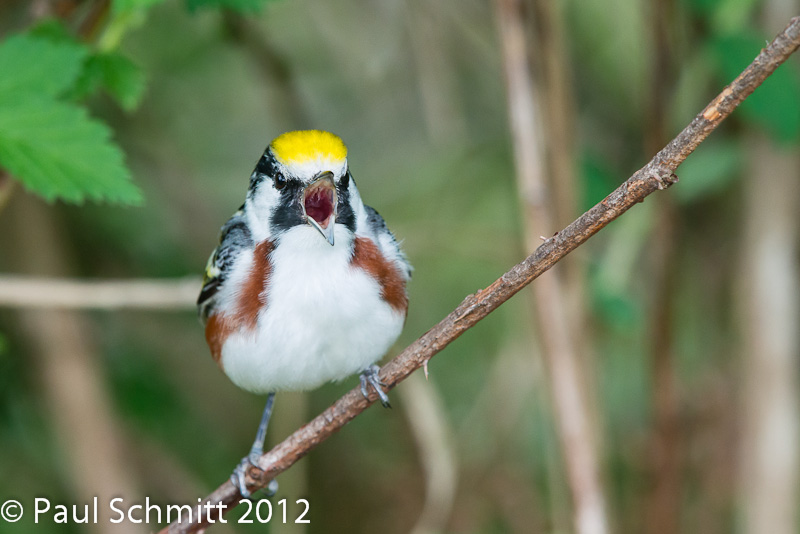
Perhaps someone can tell me why this seems humorous. I did not know they could open their beak so wide, but something makes me think he is just a loud mouth doing some bragging.
Appreciate any comments.
Paul
My bad start ended up good.
In spite of the threat of rain, I headed out to my secret little farm ponds, hoping for Wood Ducks. I was hurried, and halfway down the woods road from the car I realized that I did not have my little three legged stool. Sounds trivial, but it is basic to my moveable blind. I sit on the stool, put the tripod in front of me, hook a bungee cord from one side of the stool and across my waist to the opposite side, and then drape a camouflage cover over me. Beginning out of sight, I can slip the tripod forward, than scoot the little stool forward without needing to take hold of the stool. The bungee cord keeps the stool in place and my hands are always on the tripod for steadiness. Like a caterpillar, I can slowly move into an exposed location with good visibility. Absent the stool today, I would have to make the approach on my knees. Not fun. Then, I got to the pond and found three pairs of very vocal Canada Geese patrolling right where I wanted to be.
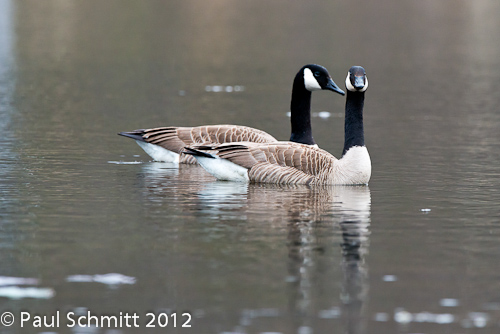
It took forty-five minutes to get in position. At times, the geese slipped to one side or another and I could move two or three slow steps on my knees. Not pleasant. At other times, I could see they were all looking the other way and I would move. In the end, I was in full view, though in camouflage, and they took no note of me from 45 feet away. I am thinking they have very short memory for what is present in a particular place. It seems their vocalization is not in alarm but just making noise. From experience, I know Wood Ducks are much more wary and would have made for a more difficult sneak. Now, I just needed the Wood Ducks to come in to the pond.
I first saw movement at the far side of the pond. Putting my long lens on the area I saw a lone drake. It seems odd that there were no other Wood Ducks, especially no hens. He seemed to be looking for company.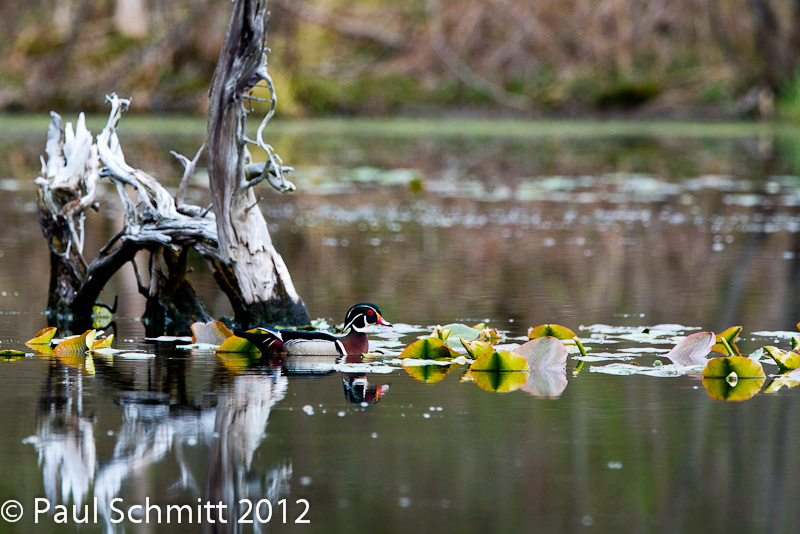
To my good fortune, the geese seemed to be drifting away to the other end of the pond and out of sight. Now, I needed the drake to complete the circuit and come around to my side.
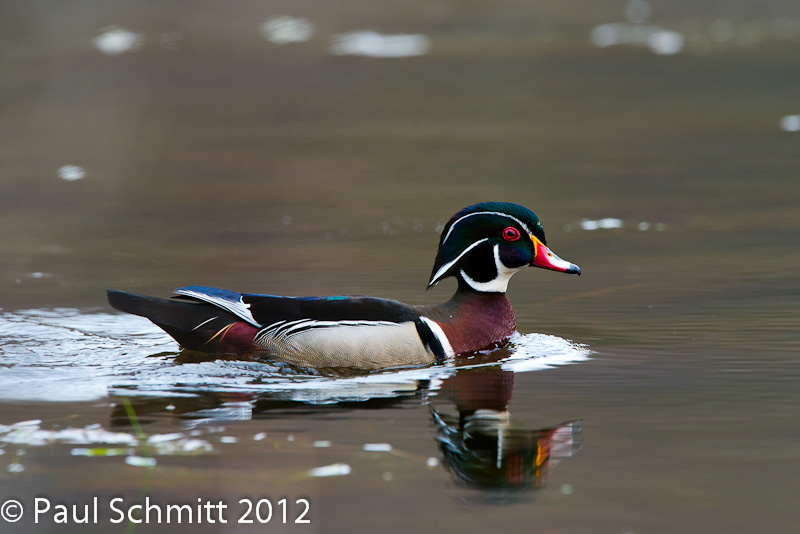
It could not have developed any better. The drake came right in front of me, only about 15 feet away. Wow, they are beautiful! And, to give a measure of their wariness, he heard the camera and did a U-turn to retreat a distance away. I was relieved that he did not take flight, but over the next twenty minutes, he teased me. Then the rain appeared. I took cover under a large hemlock tree to quickly cover my camera, lens and tripod head on a large plastic bag for a very wet hike back to the car.
These are my first bird photos with my new D800 Nikon, and I am greatly impressed with the color based matrix metering and the continuous autofocus.
Overall, not a bad day. I kept the camera and lens dry in the rain, got a nice photo and my knees don’t hurt from the abuse. Next time I will have a check list.
Paul Schmitt
Smoky Mountain Wildflowers and Waterfalls
Visited the Smoky Mountain area in the southeast United States for the first time. In addition to being rich in waterfalls, I expected to find some native wildflowers that were new to me compared to the northeastern US. I have added nearly a dozen new wildflowers to my photo galleries as a result of this outing.
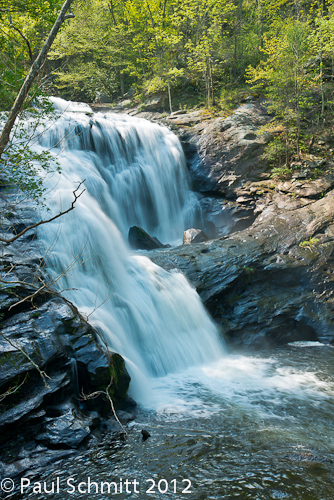
The first stop was with friends who took us to Bald River State Park in southeastern Tennessee. Rather loved this single drop and the plunge pool half way down the drop.
After a pleasant visit with our hosts, we moved on to the Smoky Mountain National Park that spans Tennessee and North Carolina. Continue reading Smoky Mountain Wildflowers and Waterfalls
Waterfalls in Coy Glen
Ray Hunt and I went to Coy Glen on Tuesday. It is a natural area of Cornell Plantations. There is one nice drop of about 12 feet with a secondary ledge about 2-1/2 feet in height. We advise caution at Coy Glen. Beyond the obscure access on Culver Road, the trail is essentially unmarked and the slope to the waterfall is steep and slippery when wet. Never attempt this alone. Please consult us before going there.
We arrived around 9:30 in the morning after a fifteen minute walk into the falls. Ray’s initial photo shows the wonderful reflections on the smooth rock surfaces below the falls.
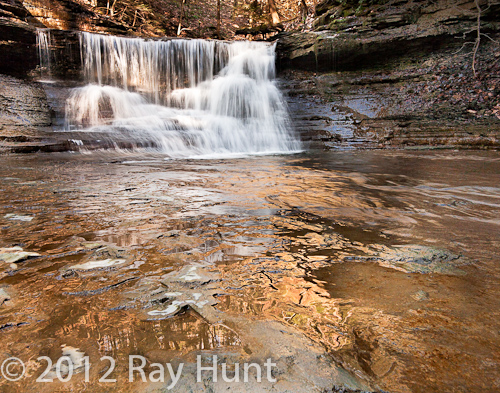
At this time in the morning, the falls were in shadow. As we photographed, we realized that we were soon going to lose the good light as bright rays of direct sunlight were approaching to blow out the left side of the falls.
It is always interesting to see how two photographers, standing near the same spot, can see a different rendition of the subject. My initial photo was different.
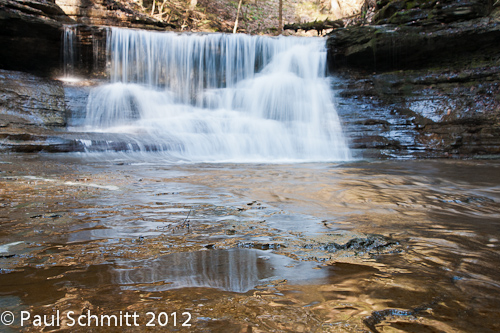
I captured less of the warm glow from my position to Ray’s right but found a pool of water that mirrored the creamy waterfall. I also chose a different aspect ratio with less foreground.
As I mentioned, there is a second drop that has fascinated me. With care, and with rubber boots reaching my knees, I can stand in the stream below the ledge and show both drops.
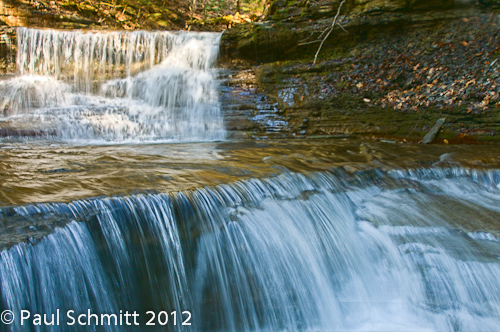
Ray pointed out that the entry of bright sunlit areas called for some HDR processing. The image above was tonal mapped using four images. Obviously, a steady tripod is required along with some adjustments to tonal values in the foreground.
The next meeting of the Cayuga Nature Photographers is to present black and white images made by the members. It has always seemed to me that waterfalls are one of the best subjects for that. So, I processed the above image in Photoshop using the RGB channels. (I will likely be on travel and miss the next meeting, so this is my contribution.)
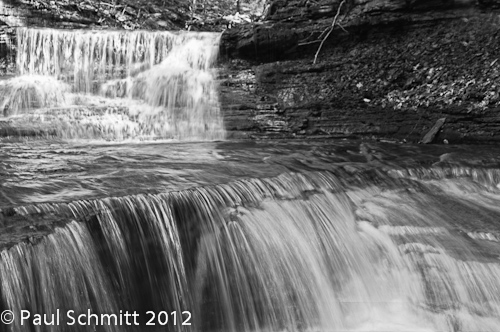
Soon, we realized we were losing the good uniform light in the gorge and began the careful climb out of the streamside. The route out requires using tree roots for hand holds initially until the ground becomes a little less steep.
Eventually, we came upon the more moderate slope and near the top, where Ray noted some beautiful fungi growing on the mossy covering of fallen tree branches. The vivid scarlet colors were too much for Ray to pass up. (I just did not expect fungi and left my micro lens in the car. Shame on me.)
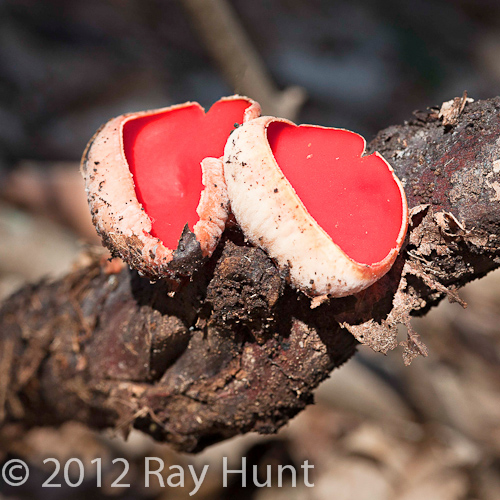
I believe this is Sarcoscypha austriaca, common name Curly-haired Elf
Cup. I was impressed that Ray had a plastic bag to kneel on while contorted on the wet ground. I never think to do that and come home with dirty knees on my pants.
It was a beautiful day, unusually warm for mid March, and perfect for two retired gentlemen to take a saunter in the woods. Ray treated me to a good cup of coffee and a delicious sour cream donut. That really made the morning perfect.
Paul Schmitt
Skunk-cabbage
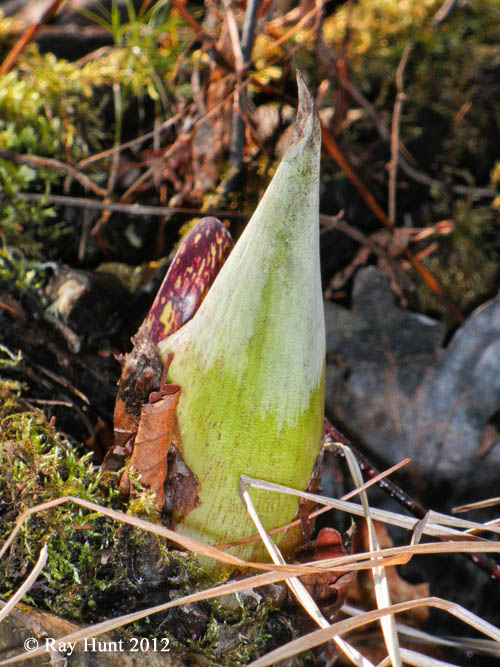
Skunk-cabbage
Chenango Valley State Park 02/21/2012
Waiting for Spring
Despite the mild winter, I am, as always come February, longing for the greens of early Spring. The tips of Day Lilies are already showing on the sunny side of the house. Buds are swelling on the trees earlier than usual.
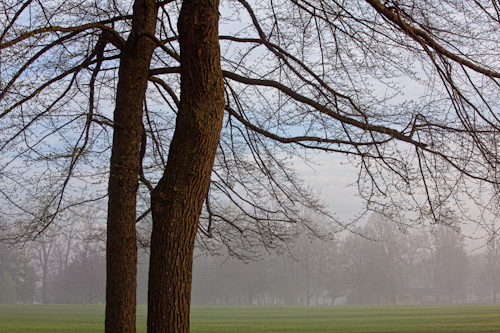
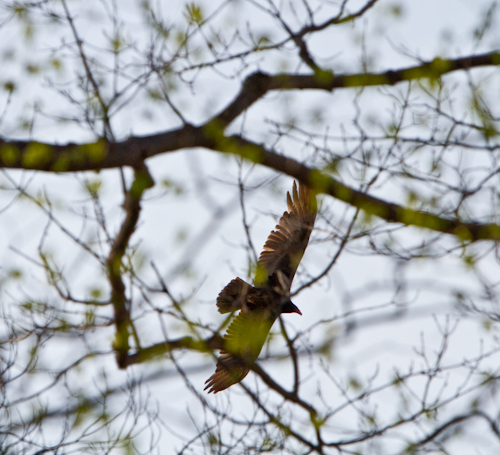
Most look for the tell-tale Robin to signal Spring’s arrival. I’ve found that the arrival of the Turkey Vultures in the gorge behind our house as an equally dependable sign.
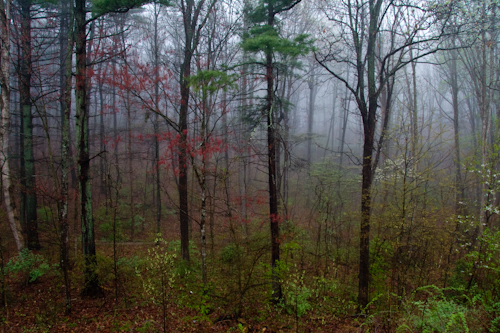
The woods of early Spring are often as beautiful and colorful as Fall. The new green is more intense than any other. And the trees glow against the contrast of nearly bare branches that still await new foliage.
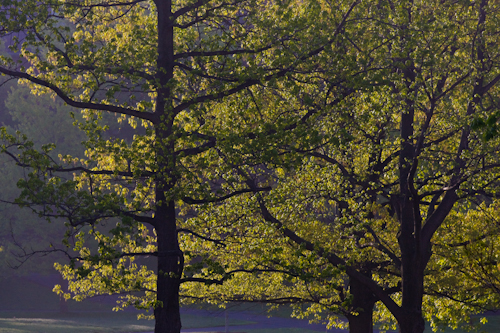
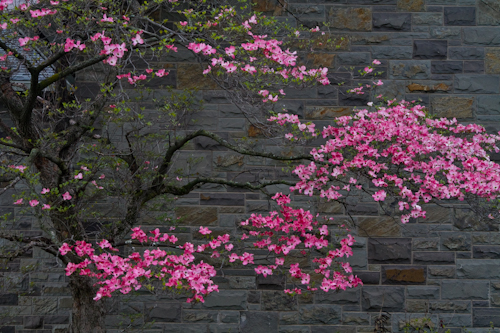
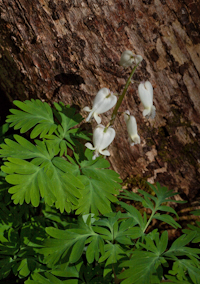 Spring blossoms arrive with colors that have been absent for what seems far too long after months of monochrome winter.
The forest floor soon comes alive with new life and the warmth of the Spring sun fills the gorges and fields. The frost is gone, the morning dew is heavy, and I am inspired by the awakening of the earth.
Post written by George Cannon.
Snowy Owl
The birders’ listserve for Ithaca has been buzzing with various sightings of Snowy Owls. Headed up to the New York Chiropractic College in Seneca Falls this morning to look for the most recent reported bird and found it on the soccer fields behind the tennis courts.
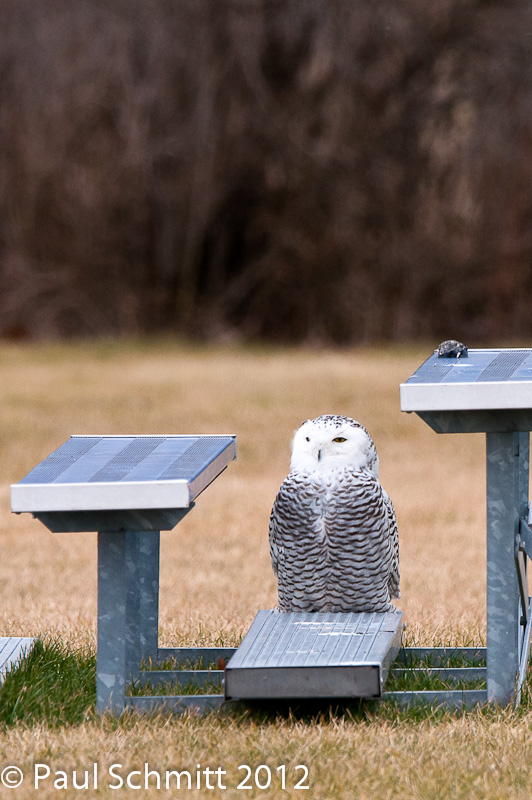
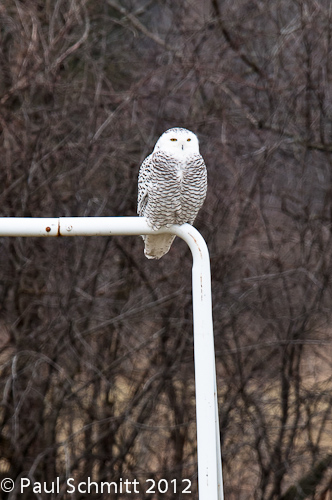
You can tell by the height of the bleacher seat that this is a pretty large owl. There were Crows in the area, and the bird moved location after a while, taking a perch on one of the soccer goals.
It moved again as the Crows became vocal, retreating to some small trees in the fence row that divides the college athletic fields from adjacent farm fields.
The Crows seemed to take increased interest in the owl and began to dive past it.
This lasted for maybe 5 minutes after which the Crows seemed to tire of their sport.
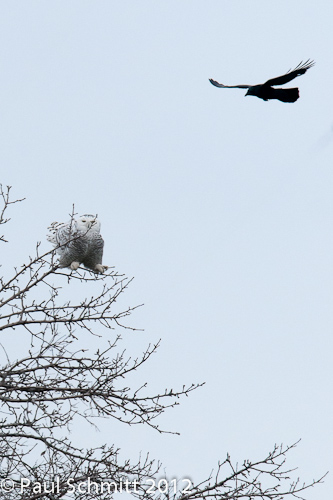
As it quieted, I noted the owl was looking intently at the surround ground beneath it. Possibly at prey? After a few minutes, the owl swooped down into the farm field, mostly hidden. We went to lunch, and when we returned the owl was out in the farm field beside a fence post. It was not at a suitable distance for a photo.
The road back to the soccer field is posted but the nice security guard inferred that on weekends, they were not concerned as long as you stay on the gravel. It is much less disturbing to the owl if you stay in the car. During the week, I would observe the owl from the maintenance building parking area. This assumes that the owl remains in the location.
Paul Schmitt
Look at the Bright Side
For those wanting to photograph Bald Eagles or waterfowl, the winter of 2012 has been frustrating. The mild winter has failed to push the birds south or to concentrate them. For me, it has also been hampering my need to test a new camera body. So, earlier this week, my patient spouse agreed to a two-day visit to the Delaware River around Lackawaxen. We saw Bald Eagles but never close enough for any interesting images. We met some nice people and stayed in a delightful B&B in Lackawaxen, the Roebling Inn on the Delaware.
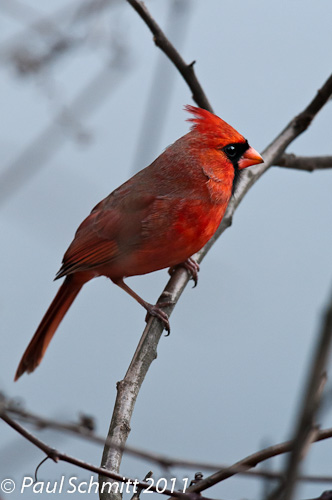
So, on the second day I camped at the Lackawaxen boat launch, camera ready and waited for the resident Bald Eagle pair to swoop down to the river. They were up on the mountain side in a roost tree. Waited until noon. Never happened. We headed home with a stop at the Mongaup blind. Waiting inside for eagles, I heard a faint “pip-pip” and found a lone Northern Cardinal just outside the blind. Try finding a small bird in a 400 mm lens at the closest focus possible! After 10 minutes, hunger overrode any vain hope for eagles. It was 3 days later that I recalled the Cardinal image.
So, was the trip fruitless? Not really, just not as fruitful as hoped. We had a nice time together including an evening by the fireplace reading peacefully. The breakfast was wonderful. The other photographers I met were a source of good intelligence for future trips. I did get useful practice on birds-in-flight, just not frame filling.
As I write this, the wind outside is blowing wickedly and there is a meager cover of snow. Like a frustrated skier, I am hoping this weather will bring reports of concentrated birds. My experience fits into the old saying “when life gives you lemons, make lemonade”. I will keep trying.
Paul
 Cayuga Nature Photographers